
UK Brexit Referendum of 2016 led the victory for the “Leave” campaign, with a total of 51.9% of the vote.
The result provoked an important debate as to the factors that contributed to the victory, with various theories and explanations.
Presentational factors during the campaign appear to be in the above list.
Campaigning in the United Kingdom European Union membership referendum began unofficially on 20 February 2016 when Prime Minister David Cameron formally announced under the terms of the European Union Referendum Act 2015 that a referendum would be held on the issue of the United Kingdom’s membership of the European Union. The official campaign period for the 2016 referendum ran from 15 April 2016 until the day of the poll on 23 June 2016.
At the close of applications on 31 March only Britain Stronger in Europe had applied to the Electoral Commission for the official “remain” designation. Three competing applications were submitted for the official “leave” designation. The Electoral Commission announced the designated campaign groups for the leave and remain sides on 13 April 2016, two days before the official ten-week campaign period began.
- Designated official leading Remain campaigning group: Britain Stronger in Europe
- Designated official leading Leave campaigning group: Vote Leave
In this article I will try to make analysis of …the during the Brexit campaign for “Leave” and “Remain”.
Leave Campaign
The “Leave” campaign was primarily based on two issues related to sovereignty and migration. The two major players involved in the Leave campaign were the UK Independence Party (UKIP) and Vote Leave. During the referendum, Vote Leave sent a huge number of targeted social media messages. One of the most discussed Leave campaign propaganda that UKIP was condemned for it is “Breaking Point” billboard, that shows a large queue of desperate refugees trying to reach Europe.

The photograph used in the poster is of migrants moving from one border to another in Slovenia, not coming to the UK. But its intention was not to be accurate; the aim of the poster was to evoke fear of an uncontrollable mass of people. This can be interpreted also as, these migrants are coming to the UK so the borders should be taken under control.
“Breaking Point: the EU failed us all” poster gained attention with multiple people during the campaign, pointing out that it resembled to the Nazi propaganda.
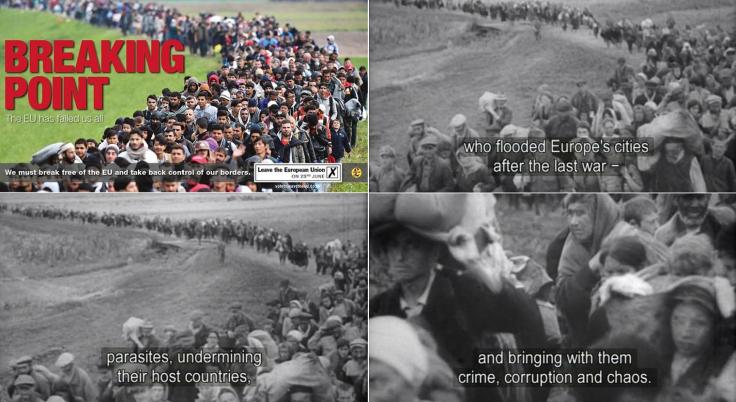
In fact if we compare this poster to a BBC documentary being shown on Netflix called “Auschwitz: Nazis and final solution” similarties are inevitable. The documentary discussed about the suffering that were endured by Soviet Jews as the Nazis moved east.
Polling data reveal a particularly interesting fact on this: Those who voted Leave had the least exposure to migrants, while those with the most exposure to them were most likely to vote Remain. It was stated that is was the fear of immigration, not immigration itself, which led the Leave camp to victory — not the reality of migrants, but the idea of them.
During the Leave campaign many other flyers were produced that had the aim to create anxiety about immigration, an example is the following:

The above Vote Leave flyer was distributed in homes of millions of British accross the UK. This displays a map of the EU represented in different shades of grey with UK rendered in Black, the countries that are numbered from 1 to 5 – Albania, Macedonia, Montenegro, Serbia and Turkey – are coloured in red and there are two other countries (Syria and Iraq) rendered in light red. This flyer can be considered as an example of misleading information. The title of the flyer “Countries ‘set to join’ in EU” is not correct, since those countries have only applied to be part of the EU and are not “set to join”. They will considered to be part of the EU only in case they meet the strict criteria required by the EU (so there is no guarantee). During the campaign Michael Gove claimed that Turkey and four other countries could join the EU and claimed it was possible this could happen within four years. So it can be clearly seen how the use of the wording is conveying a deceptive information. The fact that Syria and Iraq are in the flyer implies that these country are not that after the join of the Turkey to the EU. Even though Turkey has applied to the EU since 1999, talks have long stalled and there is no prospect of the country joining the bloc anytime soon due to human rights abuses and European Council has said that it will not open talks in any new areas.
The official Brexit campaign group was accused of deceptive data visualization.
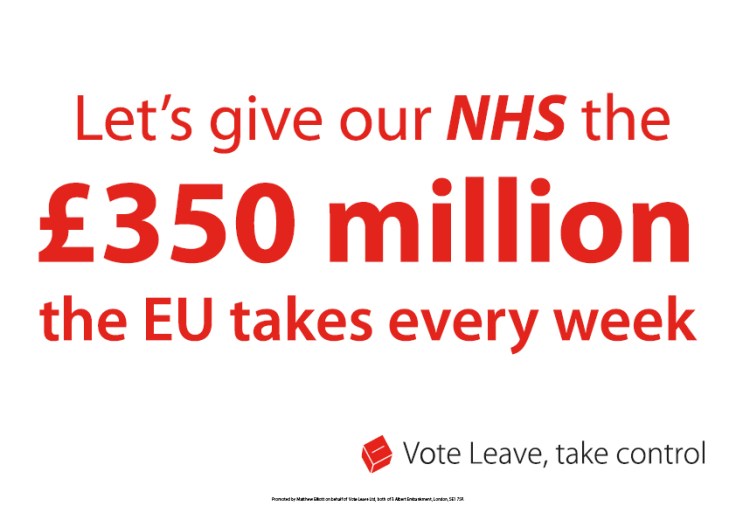 Another example of deceptive information was the widely disputed claim that the EU “costs £350 million a week. Despite warnings from the UK Statistics Authority, who accused the figures to be inaccurate, these figures were continued to be publicized during the campaign continuously.
The deception of information goes further with the Leave campaign with the following flyer.

In the above there is clearly no more difference in the colours between the countries that they claim are “set to join” the EU and one that has nothing to do with the EU such as Iraq.
Remain Campaign
The “Remain” campaign was primarily based on the fact that Britain’s economy would suffer if the country voted to Leave.

The combination of failure to believe in the economic benefits of EU membership and lack of trust in politicians led to the victory of “Leave”. The Economics of Brexit in Voters’ Eyes (or, Why the Remain campaign Failed) is a paper published as part of the ESRC-funded What UK Thinks: EU project that outlines why the Remain campaign failed to convince the voters to opt for stay in the EU:
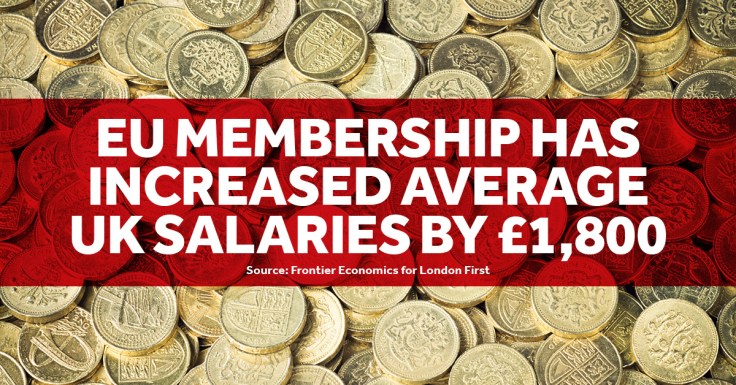
- Past EU performance: people were not convinced that Britain had benefitted economically from the EU in the past or would do so in the future;
- Voters were disinclined to trust the views of the “experts;
- Concern about immigration and identity were too important to the public’s views about the EU that they influenced the way people saw the economic case for Brexit too. Voters were not necessarily willing to focus on the economic arguments alone.
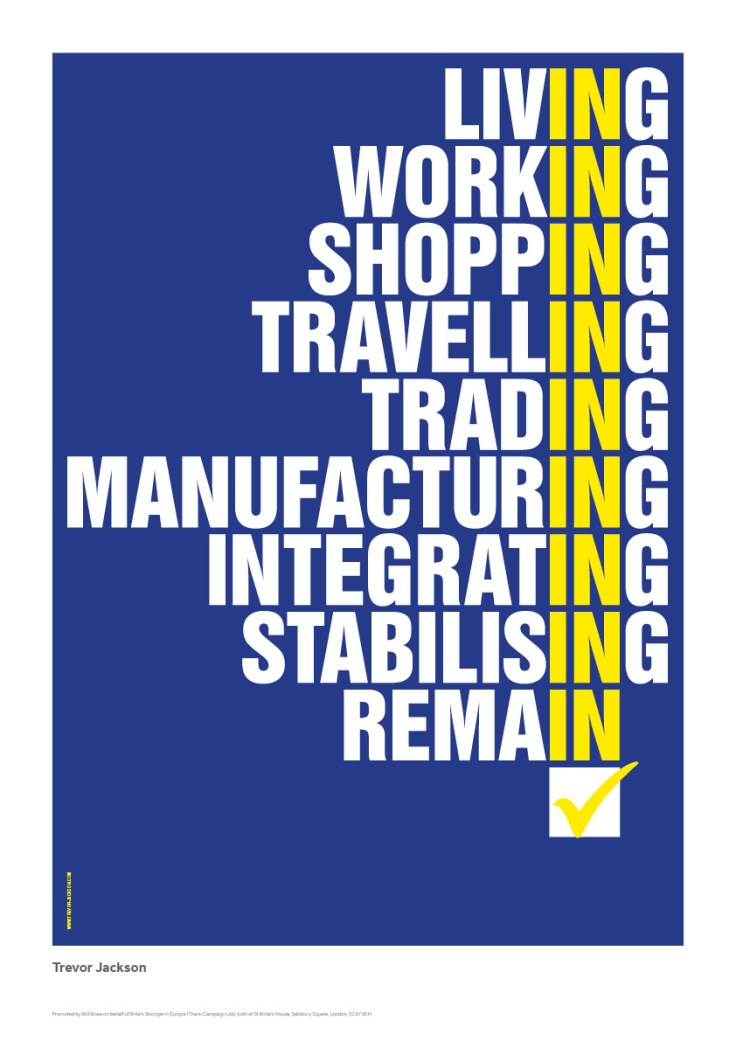
Different posters were launched during the campaign that had the aim to show the advantages of staying in the EU such as the below, that has the word “IN” highlighted in yellow in all the slogan words used in the favour of the remain campaign. The IN word leads all the way down to a tick box, inviting to vote for “Remain”.
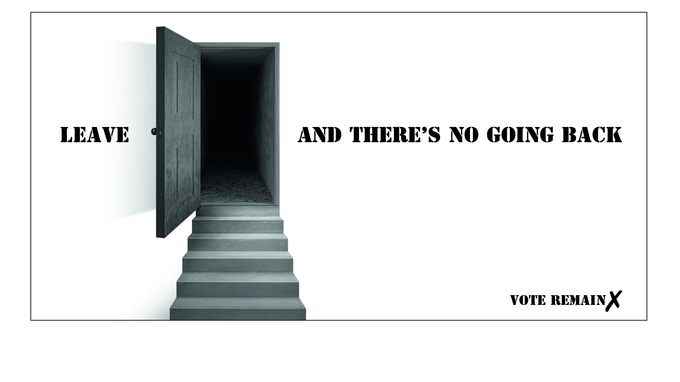
There were other posters that had the aim to highlight the dark sides of leaving the EU. The following poster by M&C Saatchi, shows stairs heading up to an open door that leads into darkness with a sentence saying “Leave, and there’s no going back”.
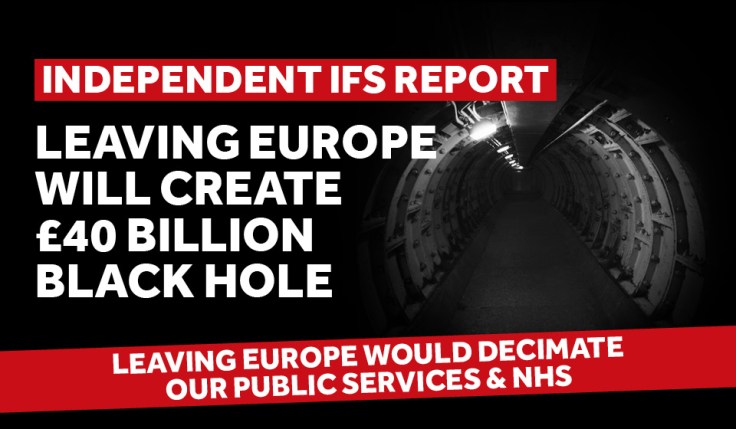
Another interesting poster that can be found on the StrongerIn website in the following:

The image depicts a woman in the center with a poster around her neck that says “We went prison for your vote. Take 2 minutes to #register”. This is being clearly aimed at encouraging the call to the polls for women.
Conclusion
The important role of the propaganda in the Brexit referendum is undeniable. But it is even more undeniable how the propaganda has been used to convey deceptive and misleading information by leveraging on people’s fear during the Brexit campaign. In particular by leveraging the fear of communities with precarious and hard-won legal and economic statuses, who want to protect those achievements because they felt them vulnerable. Some people voted emotionally; others voted based on that deception.
Reference
HyperAllergic – The Visual Propaganda of the Brexit Leave Campaign
The Guardian – Fear of immigration drove the leave victory – not immigration itself
 Gurjeet e-Portfolio