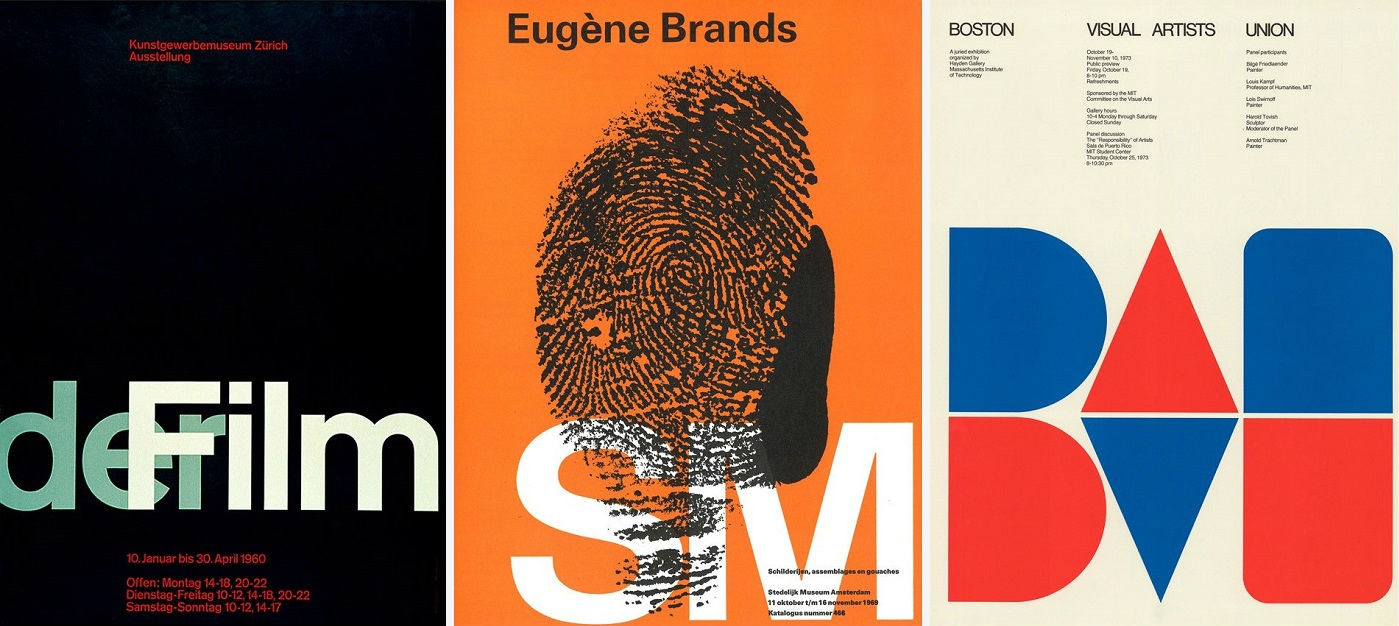
The International Typographic Style, which is also called the Swiss Style, was built up by designers from Switzerland in the middle of the 20th century. Due to its neutrality during the second world war, the country became the meeting point for intellectuals and ideas for many different places such as Holland, Russia, Germany and England.
The movement of Swiss style began at Swiss schools. The first being Kunstgewerbeschule in Zurich. This art and design institute was led by the influential Josef Müller-Brockmann. The second school involved in the development of Swiss style graphic design was Allgemeine Gewerbeschule in Basel, which was led by Armin Hofmann.
Students at these schools were never forced to adopt a certain style but instead a respect for content through simplicity was encouraged. This became the birth of Swiss style graphic design – inspired by the modernist ideal of form following function.
The Swiss style included works of book, poster, trademarks and advertising. Designers consciously moved away from illustration by using more photography. Swiss style emphasized on neatness, eye-friendliness, readability and objectivity. It was a shared interest among designers to communicate ideas universally and effectively. This basic knowledge of universal understanding made Swiss style earn its moniker dubbing it as the ‘International Typographic Style’.
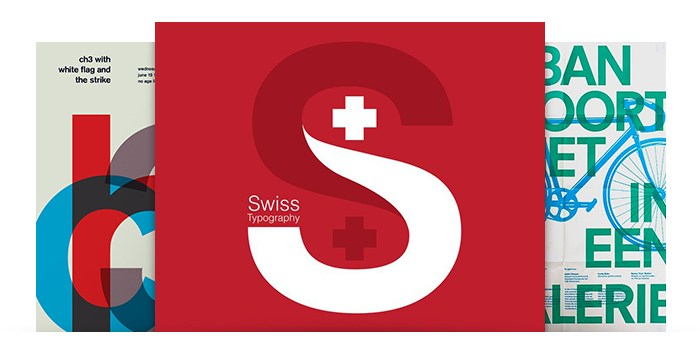
The Swiss styles is characterized by applying the norms on simple yet artistically and clearly deliver messages by:
- Preserving uniformity and geometry
- Allowing wider spacing
- Using of grid systems
- Structuring information
- Keeping minimalism
- Using sans serif fonts
- Using different fonts sizes
- Using of effective photography
Key figures of the movement
Max Bill (1908 – 1994)
He was a Swiss architect, artist, painter, typeface designer, industrial designer and graphic designer. He was student at Bauhaus school in Dessau. He became and important for his contribution to graphic design when Switzerland became the centre of the continuation of avant-garde ideas. He had admiration for Le Corbusier and shared the idea that designer should be prepared as architects. He became professor at the school of arts in Zurich in 1944.
Emil Ruder (1914 – 1970)
He was one of the major contributors to Swiss Style design. He taught that typography’s purpose was to communicate ideas through writing, as well as placing a heavy importance on Sans-serif typefaces. Ruder began his education in design at the age of fifteen when he took a compositor’s apprenticeship. By his late twenty’s, he began attending the Zurich School of Arts and Crafts when the principles of Bauhaus and Tschichold’s new typography were taught. He is distinguishable in the field of typography for developing a holistic approach to designing and teaching that comprised philosophy, theory and a systematic practical methodology.
Armin Hofman (b. 1920)
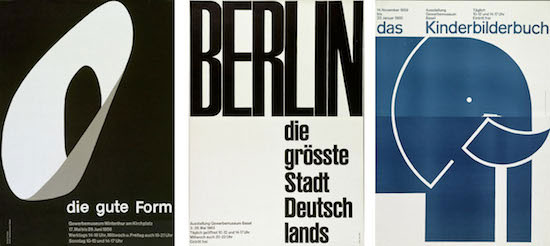
He taught for several years at the Basel School of Design and he was not there long before he replaced Emil Ruder as the head of the school. The Swiss International Style, and Hofmann, thought that one of the most efficient forms of communications was the poster and Hofmann spent much of his career designing posters, in particularly for the Basel Stadt Theater. His Graphic Design Manual was, and still is, a reference book for all graphic designers.
Josef Muller-Brockmann (1914 – 1996)
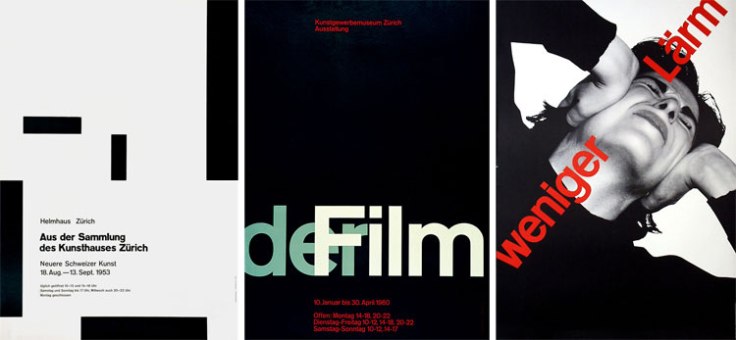
Joseph Müller-Brockmann was influenced by the ideas of several different design and art movements including Constructivism, De Stijl, Suprematism and the Bauhaus. Perhaps his most decisive work was done for the Zurich Town Hall as poster advertisements for its theater productions. He published several books, including The Graphic Artist and His Problems and Grid Systems in Graphic Design.
Herbert Matter
Matter was a Swiss born American graphic designer and photographer. He was also a master of using photomontage, color and typography in an expressive manner, transcending the boundaries between art and design. His design work often favored a heavy use of photography. His most recognizable works are the posters he created for the Swiss Tourist Office.
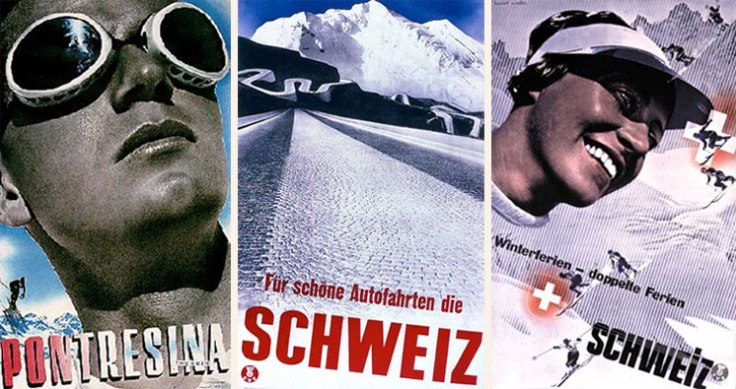
Max Huber (1919 – 1992)
He was a swiss graphic designer, artist and educator well known for his innovative and edgy approach to design. His career begins in 1935 in Zurich where he works for an advertising agency. With the beginning of the World War II – in order to avoid being drafted in the Swiss army – he moves to Milan to join the Studio Boggeri. But Italy enters the war in 1941 and Huber is forced back to Switzerland where he begins a collaboration with Werner Bischof and Emil Schultness for the influential art magazine Du.
Wolfgard Weingart (b. 1941)
He was tyesetter but became a graphic designer and typographer. He was teacher a the Basel School of Design in 1963. Even though his work come from the Swiss typographic traditional he launched a new style known as “new wave” or punk. This consisted in deconstruction of type and the rearrangement of elements in new compositions.
Swiss Typography
Akzidenz-Grotesk
Is a grotesque typeface originally released by the Berthold Type Foundry in 1896 under the name Accidenz-Grotesk. It was the first sans serif typeface to be widely usedand influenced many later neo-grotesque typefaces after 1950.
Futura
Paul Renner was a typeface designer. In 1927, he designed the Futura typeface, which became one of the most successful and most-used types of the 20th century.
Helvetica
Helvetica was developed in 1957 by Max Miedinger with Eduard Hoffmann at the Haas’sche Schriftgiesserei (Haas Type Foundry) of Münchenstein, Switzerland. Haas set out to design a new sans-serif typeface that could compete with the successful Akzidenz Grotesk in the Swiss market. Originally called Neue Haas Grotesk, its design was based on Schelter-Grotesk and Haas’ Normal Grotesk. The aim of the new design was to create a neutral typeface that had great clarity, no intrinsic meaning in its form, and could be used on a wide variety of signage.
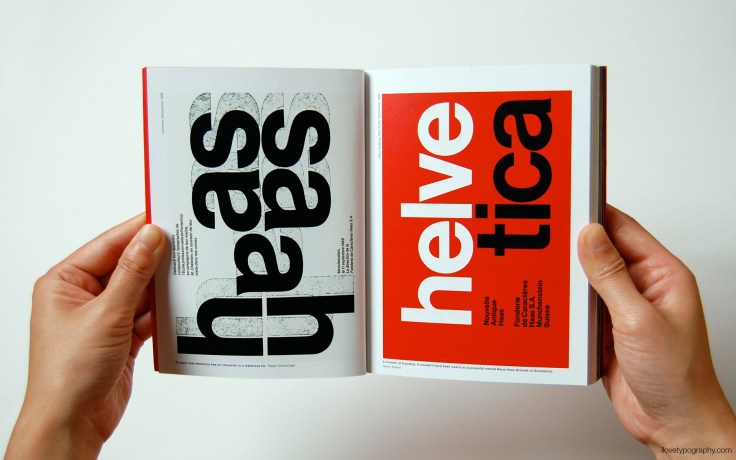
In 1960, the typeface’s name was changed by Haas’ German parent company Stempel to Helvetica (meaning Swiss in Latin) in order to make it more marketable internationally.
Univers Type Family
In 1954, Adrian Frutiger, Deberny & Peignot foundry’s art director, suggested to create a new font that would be suitable for the typesetting of longer texts. Univers type family was born 1957. It is considered to be unique because it became one of the first typefaces produced for use with phototypesetting systems.
International Typography Style
Swiss style began to internationalize thanks to official graduate programs promoted between the Design School at Yale and that of the school of Applied Arts in Basel. Student took part in exchange programmes and the American students carried their knowledge back to the States. In addition to this, another important element that spread the style was the distribution of publication like “Neue Grafik“.
European graphic designers worked in American companies and vice-versa. All these elements contribute to increase the interest in the Swiss style internationally.
International Style and Corporate Identity
In the 1950s the was over. This was the era of a huge corporate growth. At the end of the was the troops were back home, and everyone wanted a family, a house and a car. Corporate in the US were doing there best to meet these needs.
Paul Rand (1914 – 1996)
He was an American Graphic designer, lecturer and art director. He was one of the first American designers to take inspiration from Swiss Style design. He was also influenced by the avant-garde movements such as Constuctivism, De Stijl and Bauhaus.

He is very well known for his contribution to graphic design thanks to the corporate identities such as IBM, ABC, Cummins Engine, Westinghous, UPS. Rand’s defining corporate identity was his IBM logo in 1956.
Saul Bass
He was a graphic designer, film maker and illustrator, very well known for his companies logo but in particular for his creative collaboration with Alfred Hitchock and other Hollywood directors that made him a household name.
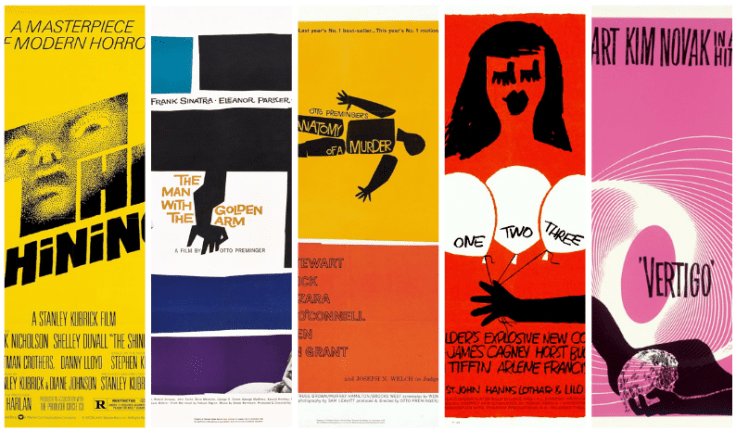
He revolutionized the way that people viewed movie titles by using the time to not just display the information but give a short visual metaphor or story that intrigued the viewer. Often times it was a synopsis or reference to the movie itself. His list of title credits include famous films such as West Side Story, Psycho, Goodfellas, Big, North by Northwest and Spartacus. He created four titles for Martin Scorsese, the last of which was for Casino.
Push Pin Studios
Push Pin Studios is a graphic design and illustration studio formed in New York City in 1954. Cooper Union graduates Milton Glaser, Seymour Chwast, Reynold Ruffins, and Edward Sorel founded the studio.
Push Pin look has nothing in common with the Swiss Style, it was often remixed with historical styles, in particular Art Nouveau, Victorian Typography and wood type. Push Pin work was characterized by very strong political statements against racial issue as well as humour.
Key figures
Milton Glaser
He is an American graphic designer and founding member of the Push Pin Studio in 1953. He is very well known for his pro bono work the “I Love New York” logo and Bob Dylan poster.
Seymour Chwast
He was a graphic designer and a founding member of Push Pin studios with Miton Glaser and Ed Sorel. He has a very wide range of styles and diverse of work.
Jacqueline Casey
She was an American graphic designer mostly known for her International style work for MIT.
Alvin Lustig
He had a varied design background, known for his contribution to book cover design and also as an interior and architectural designer. He is known for his geometric shapes, flat colours and patterns.
Elaine Lustig Cohen
Alvin Lustig’s wife, she is a graphic designer, fine art painter his style was influenced by European Avant garde. Her work is characterized by abstract elements incorporated with typographic elements.
Massimo Vignelli
He studied Architecture in Italy and moved to New York. His first major foray into the field of identity and branding was through Unimark International, which quickly became one of the largest design studios in the world.

He has designed identities for international corporations including American Airlines (which is the only airline to have not changed their identity in the past 50 years), Bloomingdales and Knoll. He favors a clarity in design and is a huge fan of using Helvetica, which can be seen in much of his work.
 Gurjeet e-Portfolio
Leave a comment