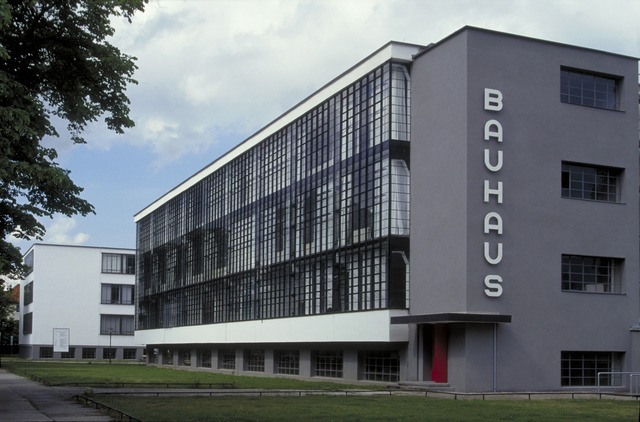
The Bauhaus movement takes its name from a German institution, named the Bauhaus, founded in Weimar (Germany) by Walter Gropius in 1919. The idea behind this school was to create a “total art work” where all the arts could be unified together. The Bauhaus style later became one of the most influential currents in modern design, Modernist architecture and art, design, and architectural education.
The school existed in three German cities—Weimar, from 1919 to 1925; Dessau, from 1925 to 1932; and Berlin, from 1932 to 1933—under three different architect-directors: Walter Gropius from 1919 to 1928; Hannes Meyer from 1928 to 1930; and Ludwig Mies van der Rohe from 1930 until 1933, when the school was closed by its own leadership under pressure from the Nazi regime, having been painted as a centre of communist intellectualism. Although the school was closed, the staff continued to spread its idealistic precepts as they left Germany and emigrated all over the world.
The Bauhaus Style
The movement was influenced by the modernism. Modernist artists sought to strip their arts of all ornamentation and reduce them to the simplest.In essence, they sought to restore the purity of art by removing everything unnecessary and leaving only the line, shape and colour. The Bauhaus movement came to define a type of Modernism known as the International Style. Simplistic in design, International art and architecture stressed functionality over everything else, and sought to challenge the way buildings, art, and even decorative objects like chairs could be used. They tended to be geometric, plainly colored or white, and useful/functional. The basic idea of this movement was the fact that they believed that art could be beautiful without ceasing to be useful. Decorative crafts, utilized as furniture or textiles in a home, were a big part of this.
Main exponents of the Bauhaus
Johannes Itten he used to teach the “preliminary course” of basics of material characteristics, composition and colour. He is known for his contribution in furthering the studies of the colour wheel that we know today. He was a follower of a fire cult originating in the US derived from the Zoroastrianism. He was very spiritual person, meditation was his main source of inspiration and practice. He used to associate colours with emotions on the basis of the temperature.
Paul Klee was a Swiss German musician and artist. He was a memeber of the “Blue Rider” that was group of artists working in abstract expressionism. He used mystical hieroglyphs forms and unconventional looking creature in his work. He was master at Bauhaus and taught bookbinding, painting and stained glass production.
Wassily Kandinsky was born in Moscow, Russia. He studied economics and law at the University of Moscow. Kandinsky always enjoyed music and painting since his childhood. A turning point in his life towards art is due to a performance of Richard Wagner’s opera, Lohengrin, where he experienced synesthesia. After leaving law he moved to Germany and attended art school at Munich. For Kandinsky, art was a spiritual and emotional experience. He wanted his painting to transcend recognized forms and express feelings through colours and shapes. He also argued that artistic experiences were all about feeling, and colours affected mood. One of his work was included in the famous 1913 New York Armory Show that introduced Americans to the European modern art movement.
Lyonel Feininger was a German American painter, caricaturist and comic strip artist. He was the first person to get the job at the Bauhaus school and he designed Bauhaus Manifesto “Cathedral” in 1919.
Laszlo Moholy-Nagy was a Hungarian painter, photographer and professor in the Bauhaus school. He experimented with photomontage and typography, he stated that the ladder is a “tool of communication” and emphasized that the type must be clear, legible and communicate the message. He succeeded in creating an asymmetrical typography. His passion for typography and photomontage inspired a Bauhaus interest in visual communication.
Hannes Meyer was director of Bauhaus after Gropius was forced to resigned from the School. He was hired to set up the architectural program in the school. Meyer had communist ideal and growth of communist student organization in the Bauhaus became a threat to the existence of the period in that period.
Joseph Albers was a German born American artist and educator who worked in Europe and United States. He was enrolled as a student at Bauhaus 1923, Gropius asked him to teach preliminary course on handcrafting due to his experience in the field. Very well known for creating furniture, such as chairs. At the Bauhaus he created a new typeface called “Kombinationshrift”, that used 10 basic geometrical shapes to create letters and numbers.
Anni Albers she is known for her integration of abstract modernism into textile weavings. She was married to Joseph Albers and together they moved to the United States when Nazi party threatened the Bauhaus.
Marianne Brandt known for her metal work, but she worked privately on photomontage and avant garde collage composition at the Bauhaus, these were kept hidden until 1970s.
Herbert Bayer, was a student at Bauhaus and after passing his final examination he was appointed by Gropius direct the printing & advertising workshop to open the Dessau location. In 1925 he was asked by Gropius to design a typeface for all Bauhaus communication. During this occasion he created the “universal” typeface a simple geometric sans serif font. He believed that a typeface needed to be functional, able to communicate so there was no need to add serif and upper case letters.
Jan Tschichold was greatly influenced by the Bauhaus approach to typography. He is most noted for his manifesto “The New Typography” in which he condemned all the typefaces except sans-serif. He rejected decoration in favour of a more rational design planned for communicative function. His design were stripped of unnecessary elements and typeface was reduced to its basic elementary shapes. In 1933 Tschichold and her wife were arrested by the Nazis, since he was accused for creating an “un-German” typography. After this event his family and him fled to Basel where he worked as a Book designer. He began to turn his back on the “New Typography” and started using roman, Egyptian and script styles in his design. Since he felt the “New Typography” was the reaction to the chaos and anarchy in Germany and that it couldn’t develop any further.
Women at Bauhaus
While women were allowed into the German school—and its manifesto stated that it welcomed “any person of good repute, without regard to age or sex”—a strong gender bias still informed its structure. Female students, for instance, were encouraged to pursue weaving rather than male-dominated mediums like painting, carving, and architecture. Bauhaus founder Walter Gropius encouraged this distinction through his vocal belief that men thought in three dimensions, while women could only handle two.
Arndt’s ambition was to become an architect, but it was only after she landed at the Bauhaus in 1923 that she realized architecture classes were not yet available at the school. She ended up crafting geometrically patterned rugs in the weaving workshop. As a self-taught photographer, Arndt began by shooting the buildings and urban landscapes around her. She also assisted her husband’s architecture firm by photographing their construction sites and buildings.
Stölzl was one of the earliest Bauhaus members, arriving at the school in 1919 at the age of 22. The same year, she penned confident diary entries that would foreshadow her success as a leading designer of the era. “Nothing hinders me in my outward life, I can shape it as I will,” one reads. “A new beginning. A new life begins,” goes another. While she experimented with a diverse range of disciplines at the Bauhaus, Stölzl focused on weaving, a department that she helmed from 1926 to 1931. There, she was known for complex patchworks of patterns, composed of undulating lines that melt into kaleidoscopic mosaics of colored squares. They took the form of rugs, wall tapestries, and coverings for Marcel Breuer’s chairs.
BAUHAUS IMPACT TODAY
Bauhaus has celebrated 100 years this year and its style principles are still applied in many works today as well. If we think of IKEA, that is one of the perfect example of the Bauhaus principle application: mass production and functional furniture. It was part of the Bauhaus philosophy that modern design should harness industrial techniques to make products accessible to everyone.

Bauhaus has revolutionized the way many architects conceptualize their work, using function as a main factor that drives the designing of their buildings.
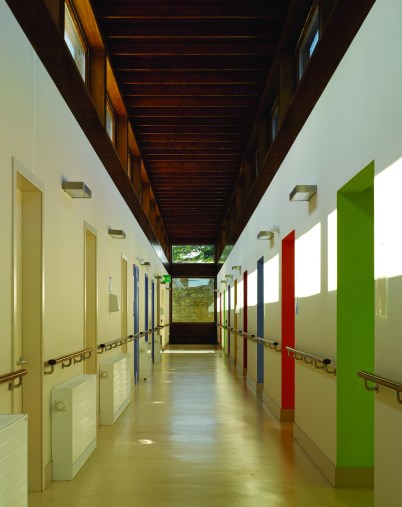
An example of Bauhaus architect can be found in Dublin: “Alzheimer’s Respite Centre” built with shorter corridors and large windows for easier way-finding.
References
Alzheimer’s Respite Centre, Dublin, by Niall McLaughlin Architects
The Local – How Bauhaus designed the world as we know it
The Guardian – Bauhaus at 100: its legacy in five key designs
 Gurjeet e-Portfolio
Leave a comment