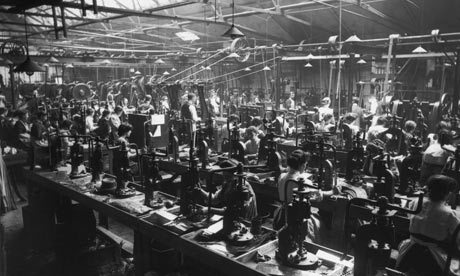
Industrial revolution (1760s – 1840s)
This period is characterized with a huge innovation in Europe and U.S. in multiple sectors. The invention of the steam engine brought huge innovation in transportation and factories (since there was no more need for these to be built on rivers). In addition to the this the invention of steel brought change in the urban architecture as well since buildings could be made much more taller. The boom in the steel industry led to the invention of the car.
The industrial revolution brought innovation in textiles and glass sector. Especially the invention in the sheet glass led to architecture creation such as the Crystal palace designed by Joseph Paxton to house the Great exhibition of 1851.
Together with innovation industrialization brought downsides effects as well such as pollution, that led to disease such as lung cancer, child labour and a huge social economical difference between the owners of the factories and worker.
During this period of change graphic communication became more and more important, such as:
- colour lytography
- typography
One of the major exponents in typographic innovation is William Caslon with the “W Caslon Jun Letter Founder” a sans serif typeface inspired by egyptian style. Wood type and pantograph took place as well, this last combined with the router led to the invention of the new wood type font.
There was more and more spreading of poster that were used to sponsor different clients such as travelling circus and theatrical groups, clothing stores. In order to make hand press stronger and efficient several improvements were thought such as the steam-powered printing press. This was invented by a German printer, Friedrich Koenig.
In 1815 William Cowper obtained the patent for a printing press using curved stereotyped plates wrapped a cylinder that could produce 2400 impressions per hour.
Linotype took leap around 1886 that was created to reduce compositer’s work time. The rapid development of lynotype caused unemployment for thousands of highly skilled hand-typesetters. However the new technology brought an explosion in the graphic design sector that came along with a high number of jobs as well. With the invention of lynotype book publishing expanded rapidly.
Photography took the leap as well during this period, photos used for different purposes such as photojournalism. The development of motion-picture photography became important as well.
The Victorian Era (1837 – 1901)
This refers to the period of the reign of Queen Victoria. Innovation of industrial revolution brought innovation in arts and industry.
Art of this period is characterized by an aesthetic confusion, gothic influence and eclectic mix.Artists conveyed the values of the era such as nostalgia, romanticism, and principle of an idealized beauty expressed through printed images of children, puppies, maiden and flowers, objects that are ornamented heavily.
The main exponents of the Victorian were:
Walter Crane, famous for his didactic and moral purpose images.
Randolph Caldecott, in his work he tend to personified dishes and plates.
Kate Greenaway she was a book designer and cloth designer.
There is born of Editorial and advertising as well, Harper and Brothers had become the largest printing and publishing firm in the world. They opened the era of pictorial magazine in 1850.
Victorian typography presented the following characteristics:
- Ornate in letterforms;
- Gothic influence, calligraphic approach;
- Extreme variations of tpe size and weight;
- design and content fill the whole page.
Arts & Crafts Movement
This movement began in England in 1860 and characterized with the focus on the quality of the materials; appreciation for old methods of production; natural materials. The style of this movement is often described as “honest” in terms of expression of function, materials and techniques of production.
The main exponents of Arts & Crafts Movement
John Ruskin (1819-1900) was an English critic of art, architecture.
William Morris (1834 – 1896) designer that focused on the design for textiles, wallpapers, book and typography. He took his inspiration from the nature. His designs were charaterized by simplicity, refreshing and decorative. He felt that the study of the nature was important to produce good design.
Kelmscott Press famous for his stylish bookworks.
Philip Webb (1831 – 1915) interested in architecture and interiors.
Charles Rennie Mackintosh (1868-1928) his art designs incorporated elements both from Art & Crafts movement as well as Art Nouveau. He is widely known for furniture designs. He is also very well known for his distinct lettering.
Eric Gill (1882 – 1940) he is very well known for his typeface Gill Sans and Perpetua.
Art Nouveau
The period of innovation and prosperity in the 19th century brought the upper middle class to support new and experimental direction in designs. France and Belgium became the leading region in the development of art Nouveau (1890 – 1910). Art Nouveau is based on:
- rejection of Victorian styles;
- rejection of historical imitations;
- fine art;
- Nature as main inspiration;
- curvilinear forms
The Art Nouveau spread in different fields – architecture, furniture and product design, fashion and graphics. Art Nouveau graphic designers try to attempt to make art a part of everyday life.
The main exponents of this period are:
Eugene Grasset (1845 – 1917) swiss artist and designer considered to be one of the pioneers of the Art Nouveau. He is famous for is posters, postcards and logos and worked in different fields such as jewellery, sculpture, painting and furniture designing. He was influenced by Japanese art as well.
Aubrey Beardsley (1872 – 1898) was a controversial and prolific illustrator, with sexual concepts described as grotesque, elegant and decadent.
Henri de Toulouse-Lautrec, inspired by Japanese art and impressionism, he has a journalistic illustrative style that captured the night life of belle epoque.
Alphonse Mucha (1860 – 1939) Czech artist and designer.
Will Bradley (1868 – 1962) famous for his poster style in the U.S.
 Gurjeet e-Portfolio
Leave a comment